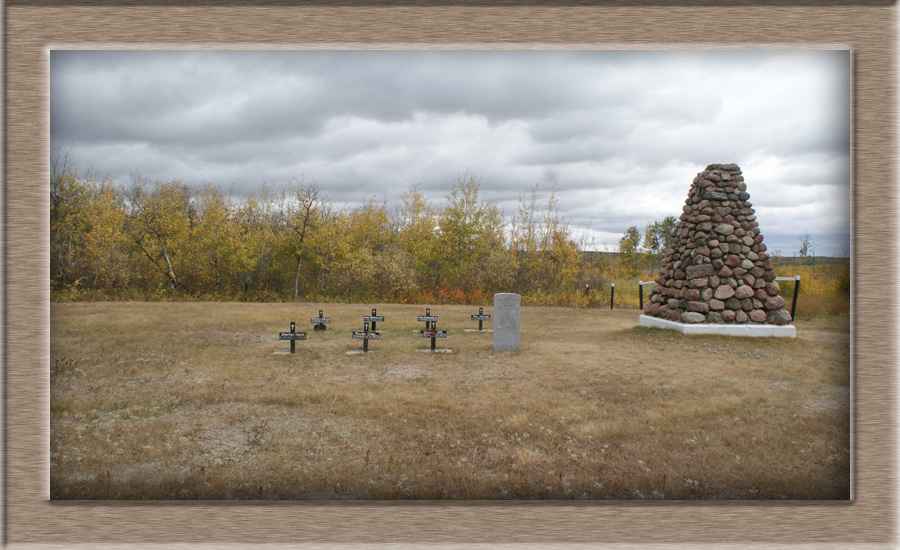
While General Middleton, Colonel Otter, and others of
our military officers, were hastening to the scene of
tumult, tidings of the most startling kind were received
from Frog Lake. Frog Lake is a small settlement, about
forty miles north of Fort Pitt, and here a number of
thrifty settlers had established themselves, tilling the
soil. Latterly, however, some enterprising persons came
there to erect a saw and grist mill, for much lumber
fringes the lake, and a considerable quantity of grain
is produced upon the prairie round about. There were only
a few white settlers here, all the rest being half-breeds.
Not far away lived detachments of various tribes of
Indians, who frequently came into the little settlement,
and smoked their pipes among the inhabitants. Here, as
elsewhere, the most bitter feelings were entertained by
the half-breeds and Indians against the Government, and
chief of all against Governor Dewdney. Every one with
white skin, and all those who in any way were in the
service of the Government, soon came to be regarded as
enemies to the common cause. Therefore, when night came
down upon the settlement, Indians, smeared in hideous,
raw, earthy-smelling paint, would creep about among
dwellings, and peer, with eyes gleaming with hate, through
the window-frames at the innocent and unsuspecting inmates.
At last one chief, with a diabolical face, said,
"Brothers, we must be avenged upon every white man and
woman here. We will shoot them like dogs. No harm can
come to us; for the great man has said so." (Alluding to
Riel.) "When they are all shot the Government will get
a big fright, and give the Indians and half-breeds what
they ask for." The answer to this harangue was the clanking
of barbaric instruments of music, the brandishing of
tomahawks, and the gleam of hunting-knives. Secretly the
Indians went among the half-breeds squatting about, and
revealed their plans; but some of these people shrank
with fear from the proposal. Others, however, said,
"We shall join you. Let us with one blow wipe out the
injustices done to us, and teach the Government that if
they deny us our rights, we will fight for them; and
murder those who are the agents of its will." So the plan
was arranged, and it was not very long before it was
carried out. And now runners were everywhere on the
plains, telling that Dumont had a mighty army made up of
most of the brave Indians of the prairies, and comprising
all the dead shots among the half-breeds; that he had
encountered heavy forces of police and armed civilians,
and overthrown them without losing a single man. They
likewise declared that he had hosts of prisoners, and
that the whole of Canada was trembling with fear at the
mention of the names of Riel and Dumont.
"Now is our time to strike," said the Indian with the
fiendish face, and the wolf-like eyes.
Therefore, the 2nd day of April was fixed for the holding
of the conference between the Indians and the white
settlers. The malignant chief had settled the plan.
"When the white faces come to our lodge, they will expect
no harm. Ugh! Then the red man will have his vengeance."
So every Indian was instructed to have his rifle at hand
in the lodge. The white folk wondered why the Indians
had arranged for a conference.
"We can do nothing to help their case," they said, "we
ourselves find it difficult enough to get the ear of
Government. It will only waste time to go." Many of them,
therefore, remained at home, occupying themselves with
their various duties, while the rest, merely for the sake
of agreeableness, and of shewing the Indians that they
were interested in their affairs, proceeded to the place
appointed for the pow-wow.
"We hope to smoke our pipes before our white brothers go
away from us," was what the treacherous chief, with
wolfish eyes, had said, in order to put the settlers off
their guard.
The morning of the 2nd opened gloomily, as if it could
not look cheerily down upon the bloody events planned in
this distant wilderness. Low, indigo clouds looked down
over the hills, but there was not a stir in all the air.
Nor was any living thing to be seen stirring, save that
troops of blue-jays went scolding from tree to tree before
the settlers as they proceeded to the conference, and
they perceived a few half-famished, yellow, and black
and yellow dogs, with small heads and long scraggy hair,
sculking about the fields and among the wigwams of the
Indians in search for food.
The lodge where the parley was to be held stood in a
hollow. Behind was a tall bluff, crowned with timber;
round about it green poplar, white oak, and some firs,
while in front rolled by a swift stream, which had just
burst its winter fetters. Unsuspecting aught of harm,
two priests of the settlement, Oblat Fathers, named Fafard
and La Marchand, were the first at the spot.
"What a gloomy day," Pere Fafard said, "and this lodge
set here in this desolate spot seems to make it more
gloomy still. What, I wonder, is the nature of the
business?" Then they knocked, and the voice of the chief
was heard to say,
"Entrez." Opening the door, the two good priests
walked in, and turned to look for seats. Ah! what was
the sight presented to them! Eyes like those of wild
beasts, aflame with hate and ferocity, gleamed at them
from the gloom of the back portion of the room. The
priests were amazed. They knew not what all this meant.
Then a wild shriek was given, and the chief cried, "Enemies
to the red man, you have come to your doom." Then raising
his rifle, he fired at Father Marchand. The levelling of
his rifle was the general signal. A dozen other muzzles
were pointed, and in a far briefer space of time than it
takes to relate it, the two priests lay weltering in
their blood, pierced each by half a dozen bullets.
"Clear away these corpses," shouted the chief, "and be
ready for the next." There was soon another knock at the
door, and the same wolfish voice replied as before,
saying,
"Entrez." This time a full, manly-looking young fellow,
named Charles Gowan, opened the door and entered. Always
on the alert for Indian treachery, he had his suspicion
now, before entering he suspected strongly that all was
not right. He had only reached the settlement that morning,
and had he returned sooner he would have counselled the
settlers to pay no heed to the invitation. He was assured
that several had already gone up to the pow-wow, so being
brave and unselfish, he said,
"If there is any danger afoot, and my friends are at the
meeting-lodge, that is the place for me, not here." He
had no sooner entered than his worst convictions were
realized. With one quick glance he saw the bloodpools,
the wolfish eyes, the rows of ready rifles.
"Hell hounds!" he cried, "what bloody work have you on
hand? What means this?" pointing to the floor.
"It means," replied the chief, "that some of your pale-face
brethren have been losing their heart's blood there. It
also means that the same fate awaits you." Resolved to
sell his life as dearly as lay in his power, he sprang
forward with a Colt's revolver, and discharged it twice.
One Indian fell, and another set up a cry like the
bellowing of a bull. But poor Gowan did not fire a third
shot. A tall savage approached him from behind, and
striking him upon the head with his rifle-stock felled
him to the earth. Then the savages fired five or six
shots into him as he lay upon the floor. The body was
dragged away and the blood-thirsty fiends sat waiting
for the approach of another victim. Half an hour passed,
and no other rap came upon the door. An hour went, and
still no sound of foot-fall. All this while the savages
sat mute as stones, each holding his murderous rifle in
readiness for instant use.
"Ugh!" grunted the chief, "no more coming. We go down
and shoot em at em houses." Then the fiend divided his
warriors into four companies, each one of which was
assigned a couple of murders. One party proceeded toward
the house of Mr. Gowanlock, of the firm of Gowanlock &
Laurie, who had a large saw and grist mill in course of
erection; creeping stealthily along, and concealing their
approach by walking among the trees they were within
forty yards of the house without being perceived. Then
Mrs. Gowanlock, a young woman, recently married, walked
out of the house, and gathering some kindling-wood in
her apron, returned again. When the Indians saw her, they
threw themselves upon their faces, and so escaped
observation. Little did the inmates know the deadly danger
that so closely menaced them. They went on talking
cheerfully, dreaming of no harm. Gowanlock, as I have
said, had been recently married, and himself and his
young wife were buoyant with hope, for the future had
already begun to promise them much. Mr. Gowanlock had
gathered the wood with which to make biscuits; and W. C.
Gilchrist, and Williscroft, two fine young men, both in
Mr. Gowanlock's employ, were chatting with him on general
matters. No one happened to be looking out of the window
after Mrs. Gowanlock came in; but about half a minute
afterwards some shadow flitted by the window, and
immediately afterwards six or seven painted Indians, with
rifles cocked, and uttering diabolical yells, burst into
the house. The chief was with this party; and aiming his
rifle, shot poor Gowanlock dead, another aimed at Gilchrist,
but Mrs. Gowanlock heroically seized the savage's arms
from behind, and prevented him for a moment or two; but
the vile murderer shook her off, and falling back a pace
or two, fired at her, killing her instantly. Three had
now fallen, and as the poor young wife fell crying, "my
God!" Croft fell pierced by two or three bullets. Lest
the work might not have been sufficiently done, the
murderers fired once more at the fallen victims, and then
came away from the house.
One of the most deserving of the settlers, but at the
same time one of the most bitterly hated, was Dunn, the
Indian agent. He was a half-breed, and had for a wife a
very pretty Cree woman. For some days past, it is said,
that she had been aware that the massacre had been planned;
but uttered no word of warning. Stealthily the blood-thirsty
band approached the dwelling of Dunn, for they knew him
to be a brave man, who would sell his life very dearly.
They were aware that in the Minnesota massacre which
happened some years ago, that he had fought as if his
life were charmed, and escaped with a few trifling wounds.
The doomed man was alone on this terrible day, his wife
having taken her blanket at an early hour and gone abroad
to "talk" with some Cree maidens. Poor Dunn was busy in
the little yard behind his house, putting handles in some
of his farming implements, and did not perceive the
approach of the murderers at all. There were five Indians
in the party, and they crept up to within a dozen paces
of where the unsuspecting man was at his work. Then,
while he whistled a merry tune, they silently raised
their rifles and took aim. The unfortunate man fell,
pierced with all their bullets and made no stir.
Another detachment of the bloodhounds directed their
steps towards the residence of Barnez Fremoine, the
Belgian rancher. He was a tall, magnificently-built man,
and when the savages got in sight of his house they
perceived that he was engaged oiling the axle of his
waggon.
Aided by the shelter of an outhouse, they approached
within twenty yards of this victim; raised their arms
and arrows and fired. He fell likewise without uttering
a cry, and made no stir. When found afterwards there were
two bullet holes in his head, and an arrow lay lodged in
his breast. [Footnote: This fact I get from correspondence
to the Ottawa _Free Press_, a newspaper which, under the
great journalistic enterprise of Mr. J. T. Hawke, has
kept the people at the Capital well informed from day to
day on affairs at the scene of tumult.] Two other persons
were surprised in the same way, and shot down like dogs,
making a total of eleven slaughtered.
The first official confirmation of the dreadful tragedy
was given in a despatch, sent from Fort Pitt to Sir John
Macdonald, by police inspector Dickens, a son of the
immortal novelist.
-The Story of Louis Riel: the Rebel Chief
>
(Primary source documents / Timeline)
|